
If you run a resort or homestay in Kodagu or Chikkamagaluru, you know where a large part of your bookings come from: online travel agencies. They bring guests you would never reach on your own. They also take a cut of every booking. A resort direct booking website does not replace OTAs, but it lets you keep more of the money from guests who already know you, and cut the OTA commission you pay on them.
This guide explains how OTA commission works, the simple maths of moving some bookings direct, what your website needs to take bookings properly, and how to run the property once bookings start coming from everywhere.
How OTA commission works
Online travel agencies such as MakeMyTrip, Goibibo, Booking.com, Agoda and Airbnb list your rooms, take the booking and charge you a commission or service fee on it. The exact figure depends on the platform, your contract, your location and which promotional programmes you have joined.
As a rough guide, OTA commission for hotels and resorts in India is commonly quoted somewhere between 15% and 25% of the booking value. Some properties pay less on basic plans. Others pay more once they add visibility boosts, preferred-partner badges or discount campaigns. Treat these as typical market figures, not exact rates. Your own contract and monthly invoices are the only numbers that matter.
A few things often catch owners out:
- Discounts you fund still attract commission. If you agree to a member deal or a festival sale, you give the discount and then pay commission on what is left.
- Money can arrive late. When the platform collects payment from the guest, your payout may come days or weeks after the stay.
- Guest details may be limited. Contact details are often masked, which makes it harder to invite the same guest back later.
- Rate parity terms. Some contracts restrict how you price on your own channels. Read your agreement before you advertise a cheaper rate on your own site.
The maths of shifting some bookings direct
You do not need to move every booking away from OTAs. Even a modest shift adds up. Here is a purely hypothetical example to show the arithmetic. Replace these figures with your own.
Imagine a 12-room property near Madikeri that sells 1,500 room nights a year through OTAs at an average of ₹6,000 per night, paying an average commission of 18%.
| Item | Hypothetical figure |
|---|---|
| OTA room revenue (1,500 nights at ₹6,000) | ₹90,00,000 |
| Commission paid at 18% | ₹16,20,000 |
| Room nights moved to direct booking (20%) | 300 nights |
| Revenue on those 300 nights | ₹18,00,000 |
| Commission no longer paid on them | ₹3,24,000 |
| Payment gateway charges, assumed at about 2% | ₹36,000 |
| Approximate yearly saving | ₹2,88,000 |
Two honest caveats. First, direct guests still cost something to win: website upkeep, staff time on WhatsApp, and any Google ads you choose to run. Second, a few of those guests might have found you anyway. The point is not the exact figure. It is that every rupee of commission you avoid goes straight to your margin, and a guest who books direct once is far easier to bring back for the next long weekend.
Use OTAs for discovery, convert repeat guests direct
The practical approach for most Coorg and Chikkamagaluru properties is a split:
- Let OTAs do what they do well. They put you in front of first-time travellers from Bengaluru, Mysuru, Chennai, Hyderabad and further away.
- Make your own website the easiest place to book the second time. Give a clear reason: a meal plan included, a coffee estate walk, early check-in when rooms allow, or simply a faster and more personal reply.
- Ask for consent at checkout. Ask guests whether they would like offers on WhatsApp or email, and save their details in your own system, not in a register that nobody opens again.
- Follow up after the stay. Send a thank-you message, a link to leave a Google review and a direct link to book their next trip.
Value-adds are usually simpler than a lower headline rate, especially if your OTA contract has parity terms.
It also helps to remember how people shop. A traveller often finds you on an OTA app, then searches your resort's name on Google to look at more photos and reviews. If your own website and Google listing appear there with a clear Book direct button, some of them will book with you instead.
What a direct booking website actually needs
A nice homepage with a phone number is not a booking website. If a guest has to call, wait for a reply and transfer money to a personal account, many will go back to the OTA app. These are the parts that matter.
Rooms, rates and live availability
Show each room or cottage type with real photos, bed type, maximum occupancy and what the view actually is. Rates should change by season: weekdays, weekends, long weekends, Dasara, and the Christmas to New Year rush. Availability must update automatically so a cottage booked on an OTA disappears from your website at once.
Packages
Guests in Kodagu and Chikkamagaluru often book an experience, not only a room. Coffee estate walks, all-meals plans, campfire evenings, birding mornings and honeymoon add-ons all sell better when they are packaged with a clear list of what is included and what costs extra.
Payments by UPI and a payment gateway
Guests expect to pay by UPI, card or net banking. A payment gateway such as Razorpay, Cashfree or PayU handles this and settles money into your business current account. Charges vary by provider and payment method; card payments are commonly charged at around 2% per transaction, so check the current rates you are offered. Decide whether you take full payment or an advance, and say so clearly before the guest pays.
Policies in plain words
Check-in and check-out times, cancellation and refund rules, child and extra-bed charges, pet policy, ID requirements, and rules on music or outside food. Clear policies on the website prevent awkward conversations at the front desk.
WhatsApp, set up properly
Many guests want to ask one question before paying, such as whether the estate road is fine for a sedan during the monsoon. A WhatsApp button that opens a chat with your front desk number answers that. With WhatsApp automation, booking confirmations, directions, pre-arrival reminders and checkout thank-you messages go out on their own.
Fast on mobile data
Many guests browse on a phone, and network coverage near estates can be patchy. Compressed photos and light pages make the difference between a booking and a closed tab.
We cover the full feature list on our resort website and booking software page.
Get found on Google, not only on OTAs
When someone searches for resorts near Madikeri, Virajpet, Kushalnagar or Chikkamagaluru town, Google shows a map listing first. Your Google Business Profile is free and deserves attention:
- Place the pin at your gate or reception, not at the nearest junction. Estate stays are often a few kilometres off the main road, so add clear directions on your website too.
- Upload real photos of each cottage type, the dining area, the view and the approach road.
- Fill in amenities such as parking, pool, restaurant and Wi-Fi accurately.
- Reply to every review, including the critical ones, calmly and specifically.
- Link the website button to your booking page, not just your homepage.
Google also shows room prices and booking links for hotels in Search and Maps. A property can appear there with a link to its own official site through a booking engine or channel manager that connects to Google. Ask your software provider whether theirs supports this. If you would rather have the listing handled for you, see our Google Business Profile setup service.
Run the property from one screen with Resort Prime
Direct bookings only help if the rest of the operation keeps up. When bookings arrive from several OTAs, your website, phone calls and WhatsApp, a paper register or a shared spreadsheet is where double bookings start.
Resort Prime is our software for resorts and homestays. It covers:
- Front desk: check-ins, check-outs, guest details, advances and balances.
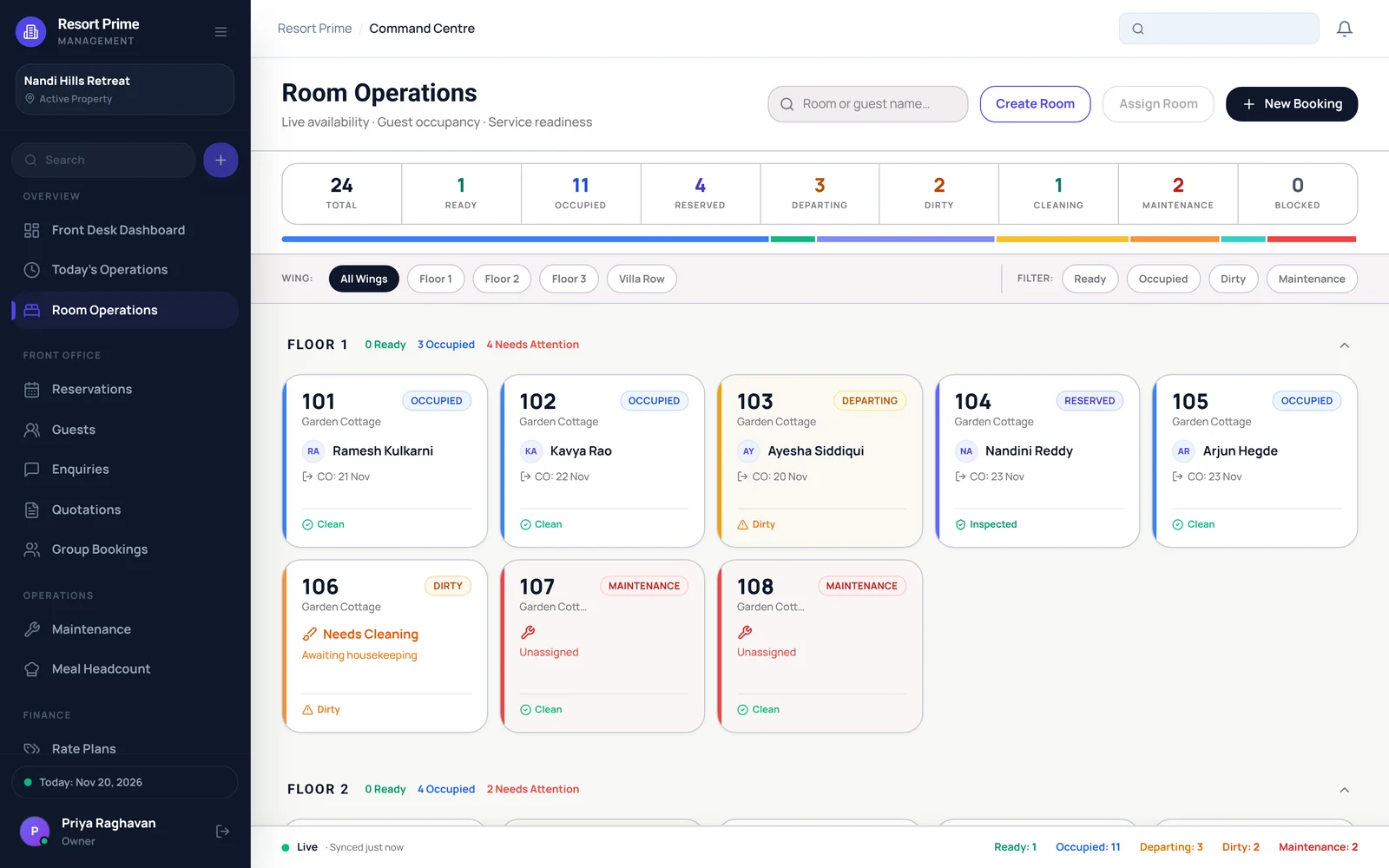
- Live room board: which cottages are occupied, arriving, departing or being cleaned, at a glance.
- Reservations from every channel: OTA, website, phone and walk-in bookings in one list.
- Housekeeping: rooms marked dirty, in progress or ready, so the front desk knows what it can hand over.
- Billing: room, food and extras on one bill at checkout.
The owner can see the same picture from Bengaluru or anywhere else, without calling the manager for an update.
A simple plan for the next season
- Find your number. Total last year's OTA invoices to see exactly how much commission you paid.
- Decide your direct-guest offer. Pick a value-add you can deliver every time.
- Set up the website with live availability, packages, clear policies and UPI or gateway payments.
- Fix your Google listing so the pin, photos and booking link are right.
- Collect consent at checkout and keep guest details in your own system.
- Review after a few months. Count direct bookings and what they cost you to win, then adjust.
Working with resorts in Kodagu and Chikkamagaluru
We are based in Ullal, west Bengaluru, and work with resort and homestay owners across Karnataka over calls, video calls and WhatsApp, visiting the property when it helps. Read more about our website development in Kodagu (Coorg) and website development in Chikkamagaluru.
Want to see what your own numbers look like? Talk to us. We start with a free call and give you a fixed written quote before any work begins.
Frequently asked questions
Will a direct booking website reduce my bookings from OTAs?
It should not, and that is not the goal. OTAs keep bringing first-time guests. Your own website gives returning guests and people who search your resort by name an easy way to book with you, so a larger share of total bookings avoids commission.
Can I show a lower rate on my website than on MakeMyTrip or Booking.com?
That depends on your contract. Some OTA agreements include rate parity terms. Read yours first. Many properties reward direct guests with value-adds instead, such as a plantation walk, a meal or flexible check-in, rather than a lower headline room rate.
How do guests pay on a resort booking website?
Through a payment gateway that accepts UPI, cards and net banking and settles the money into your business current account. You choose whether to collect full payment or an advance, and your cancellation and refund rules should be shown before the guest pays.
Is a direct booking website worth it for a small homestay with three or four rooms?
Often yes. Small homestays depend heavily on repeat guests and word of mouth, which are exactly the guests who can book direct. The website can be simple: rooms, photos, rates, availability, a payment option and a WhatsApp button.
How do I stop the same cottage being sold twice on different channels?
You need one live view of availability across your website, OTAs, phone and walk-in bookings, updated the moment a booking comes in. Resort Prime keeps reservations from every channel on one room board. Tell us your current setup and we will explain how it fits.