
How a borewell drilling business really runs
A borewell contractor runs a moving business. The rig and the support lorry leave early, reach a farm or a house plot, and drill until water comes or the customer decides to stop. The office is usually the owner's phone, a diary and a stack of WhatsApp chats. That is where borewell billing software has to fit: in the hands of the owner and the rig operator, not on a desktop in a back room.
Most jobs follow the same pattern, and most of the money problems come from the same few places.
- A customer calls, a date is fixed and an advance is taken to book the rig
- The rig reaches the site and drilling starts; depth is counted in feet, rod by rod
- Casing pipe is lowered through the soil and loose rock, and charged by the foot
- Diesel is filled for the rig and the compressor, often at a pump on the way
- The crew works long days and takes advances against wages through the month
- At the end, the bill is worked out by depth slab, and the balance is collected, sometimes on the spot and sometimes months later
- The bill usually goes to the customer as a photo or a typed message on WhatsApp
Where the money leaks in borewell drilling
None of this is complicated, but it is easy to lose track when you run one or more rigs across many villages in a season. These are the gaps contractors tell us about most.
Depth-slab rates worked out by hand
Most contractors charge by depth slab: one rate per foot for the first slab, a higher rate for the next, and higher again as the bore goes deeper, because deeper drilling takes more time, diesel and wear. Working this out on a calculator at the end of a long day leads to mistakes, and a wrong bill either loses you money or starts an argument with the customer.
Balances nobody is chasing
A farmer pays an advance, the bore is drilled, and the balance is promised after harvest. Multiply that by a full season and the money to collect is spread across dozens of diary pages. Without one list of who owes what, some of it is simply never collected.
Diesel you cannot account for
Diesel is one of the biggest running costs on a rig. If you cannot see diesel per rig against the feet that rig drilled, you cannot tell whether a rig is costing too much or whether fuel is going missing.
Crew attendance, wages and advances
Crews move between rigs and take advances through the month. Working out who was present, how many days, and how much is still owed after advances is a monthly headache that a notebook handles badly.
Bore Prime: a borewell drilling management app on your phone
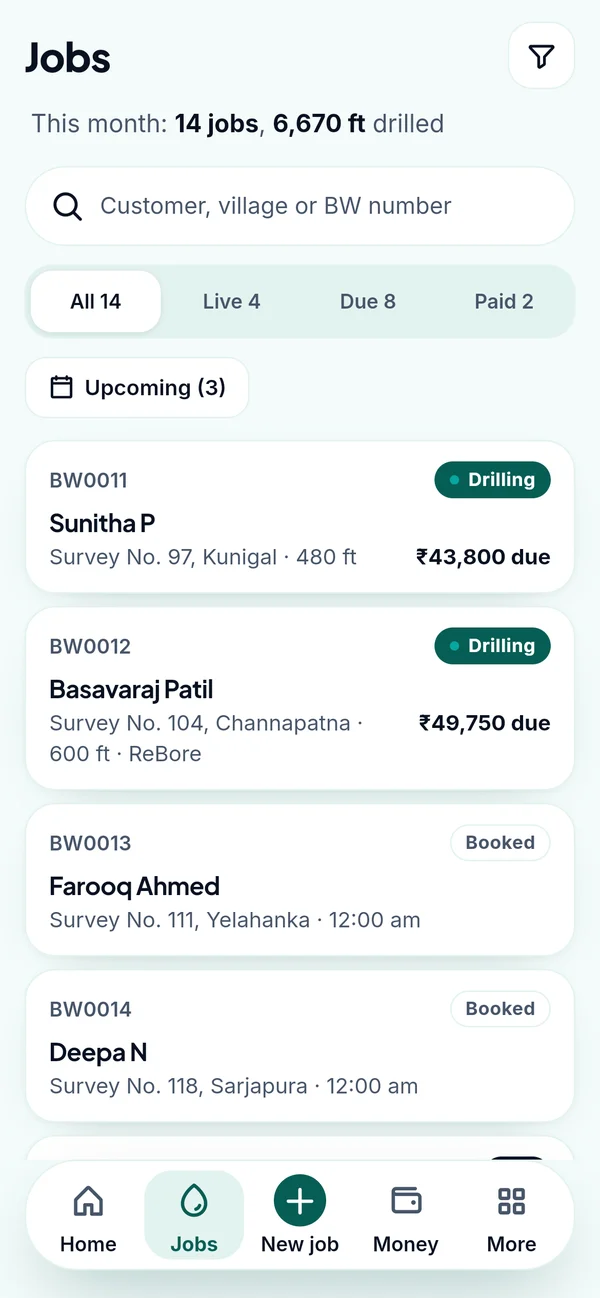
Bore Prime is our own product for borewell drilling contractors. It tracks every borewell from booking to final payment, on your phone. It does four things, and does them in the way the trade already works.
Live jobs and depth drilled
See every job that is booked, drilling now or finished, with the depth drilled in feet. When the operator logs depth as they drill, you know how far each rig has gone without making a call.
Bills by depth slab, sent in one tap
Set your rate for each depth slab once. As depth is logged, the bill builds itself from those rates, so the amount is the same whether you, your manager or your operator prepares it. When the job is done, the bill is sent to the customer in one tap.
Money to collect and profit this month
One screen shows who owes you and how much, across every job. Next to it you see profit this month, so you know whether the season is actually paying, not just how busy the rigs have been.
Diesel per rig, crew attendance and wages
Record diesel against each rig and see where the diesel went. Mark crew attendance and keep wages in the same place, so month-end settlement is a quick check instead of an evening of arguments over the diary.
Built for contractors across north Karnataka
Borewells matter in every part of Karnataka, but they matter most where rain is short and farms depend on groundwater. Across the dry districts of north Karnataka, many farms rely on borewells for irrigation, and drilling contractors are busy for much of the year. Grape growers around Vijayapura, farms across Bagalkot district, and tur dal farms around Kalaburagi, are typical customers, as are farms around Raichur and Koppal.
We are based in Bengaluru, and we work with contractors across Karnataka over calls, video calls and WhatsApp. A demo takes about 30 minutes, and we show you Bore Prime with data that looks like yours. We can also visit when it helps, for example to set up the app with your rig operators.
When you need more than Bore Prime
Some contractors also sell submersible pumps, do pump installation and repair, or run hydro-fracturing and bore flushing as separate services. If your business has needs Bore Prime does not cover, our custom software team can build around it, for example a pump stock register or a separate rate card for flushing jobs.
Customers search for borewell drilling near me on Google Maps more than anywhere else. A simple contractor website and a well-kept Google Business Profile with your rig photos, service areas and phone number bring in bookings without depending only on word of mouth. To send booking confirmations and balance reminders automatically, see WhatsApp automation.